Explore the museum
Explore the extensive and ever-growing collection of trackers for each platform, featuring detailed information.
Explore the extensive and ever-growing collection of trackers for each platform, featuring detailed information.

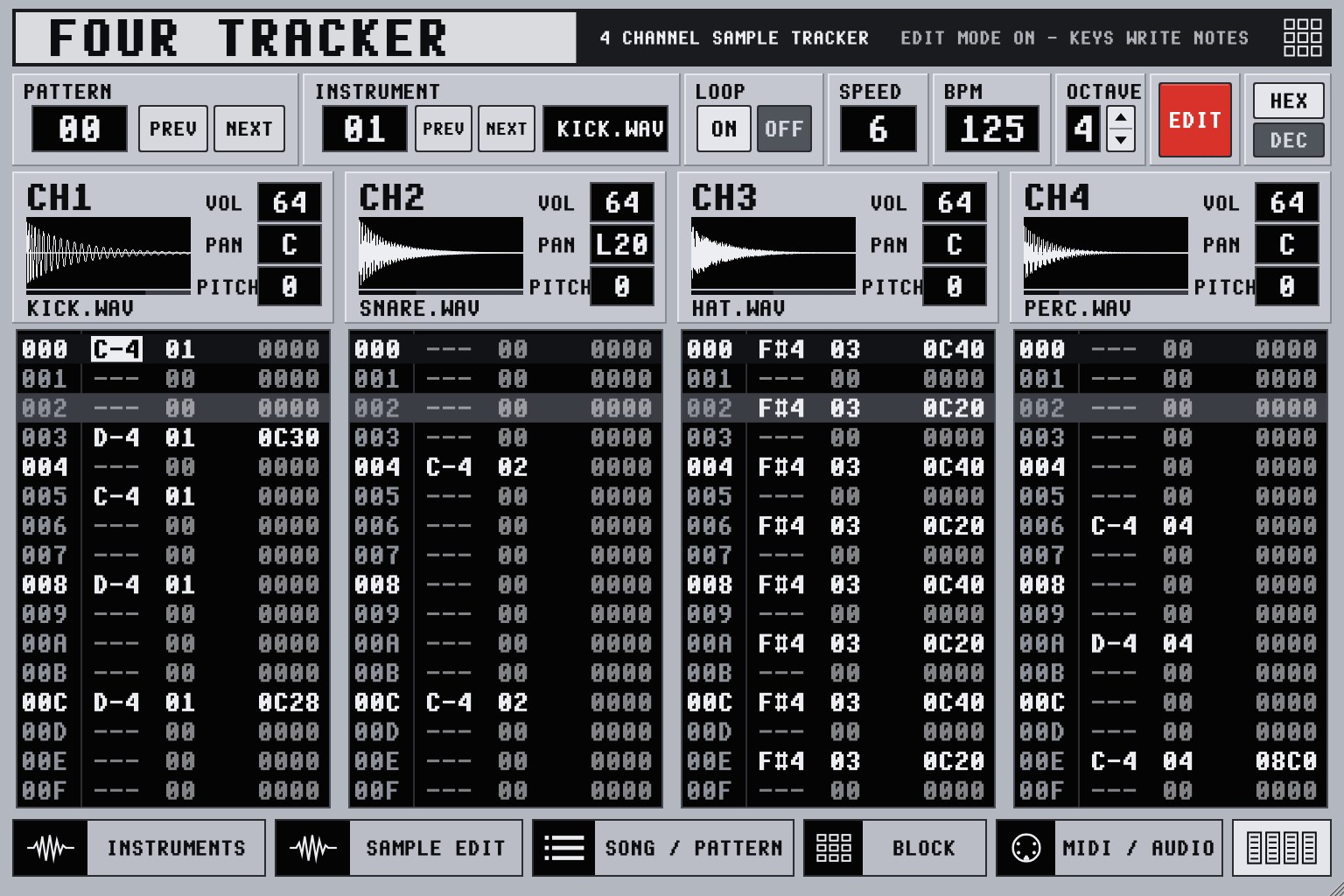
Four Tracker is a free music tracker for Windows inspired by ProTracker, FastTracker 2 and OctaMED. It combines traditional sample-based composition with built-in synthesis, VST3 effects and live MIDI control. Available as both a standalone application and a VST3 instrument, it brings the familiar tracker workflow into a modern studio setup.
Despite its name, Four Tracker supports 1 to 16 tracks, with 64 patterns containing up to 256 rows each. Notes, instruments and effects are entered in a classic tracker grid, with hexadecimal or decimal display options. Its FastTracker 2-style commands include arpeggio, portamento, vibrato, retriggering, note delay and pattern loops.
One of its distinctive features is live pattern switching from a MIDI keyboard. Musicians can trigger patterns while playback continues, choosing transitions on the next row, the next beat or at the end of the current pattern. This makes it possible to improvise arrangements and perform with patterns in real time.
Four Tracker loads WAV, AIFF, FLAC, Ogg and MP3 samples, alongside Amiga IFF 8SVX and raw 8-bit sounds. Its sample editor provides trimming, looping, reverse playback, fades, normalization and sample mixing. The 16 instrument slots can also use built-in synthesizers, ranging from a single-waveform engine to a two-oscillator synth with modulation and onboard effects.
The standalone application supports ASIO and accommodates three VST3 effects per track, plus three on the master output. MIDI instruments can control external hardware or software synthesizers, while a chord mode distributes played notes across adjacent tracks.
Four Tracker connects the sample-driven traditions of Amiga-era trackers with modern plugin processing and performance controls. It is currently in beta development.
Source: Four Tracker official website.